-
Follow Us On:
-
-

Interventional Cardiac Therapies (ICT)
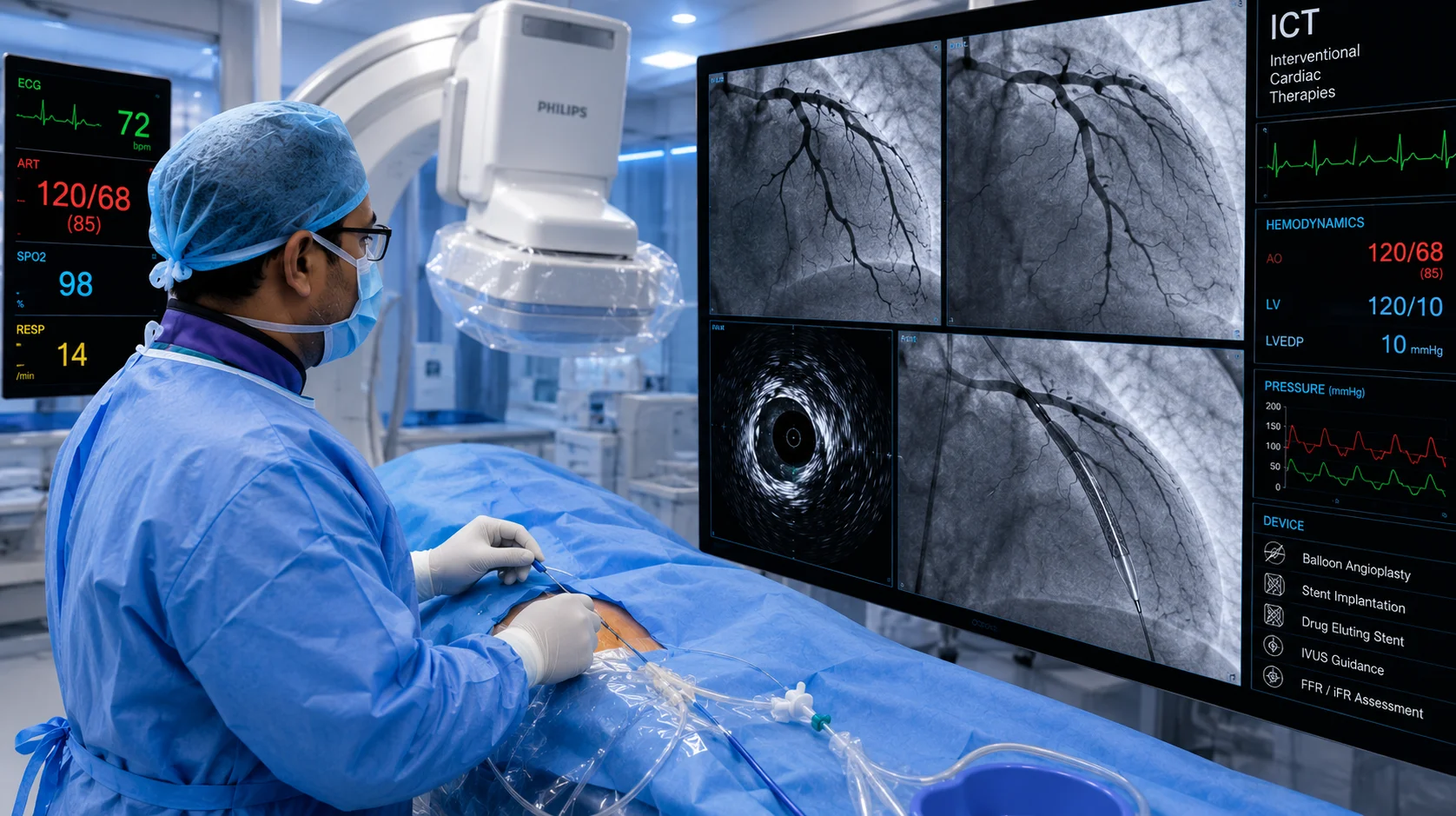
Interventional Cardiac Therapies (ICT)
Interventional Cardiac Therapies (ICT) include minimally invasive catheter-based procedures used to diagnose and treat blocked arteries, complex coronary disease, and selected heart conditions with precision-guided technology.
What Interventional Cardiac Therapies Include
-
Coronary Angiography and Angioplasty: Diagnose and open narrowed heart arteries using advanced catheter-based techniques.
-
Image-Guided Intervention: IVUS and OCT support better lesion assessment, stent sizing, and final procedural accuracy.
-
Complex Coronary Angioplasty: Advanced treatment for bifurcation lesions, calcified arteries, left main disease, and chronic total occlusions.
-
Emergency and Primary PCI: Rapid catheter-based treatment to restore blood flow during acute coronary syndromes and heart attack.
-
Selected Structural Therapies: Chosen minimally invasive cardiac procedures tailored to anatomy, symptoms, and specialist assessment.
Why Interventional Cardiac Therapies Are Important
-
Restore coronary blood flow before heart muscle damage worsens.
-
Combine diagnosis and treatment in one coordinated pathway.
-
Support precise stent planning with modern interventional imaging.
-
Offer less invasive treatment than open surgery in selected patients.
-
Improve symptom control, recovery time, and long-term heart care.
Who May Benefit From ICT
-
Patients with coronary artery disease needing targeted catheter-based treatment.
-
People with complex lesions who need advanced interventional planning and imaging support.
-
Patients with acute coronary syndromes who may require fast revascularization.
-
Individuals selected for minimally invasive heart treatment instead of a larger surgical pathway.
Benefits of Interventional Cardiac Therapies
-
Supports earlier restoration of blood flow and symptom relief.
-
Uses minimally invasive access routes with shorter recovery in many cases.
-
Improves precision through imaging, device selection, and lesion preparation.
-
Helps reduce future ischemic events and supports structured follow-up care.
Book an ICT Consultation
Consult Dr Sandeep's Heart Care Center & Labs to know whether Interventional Cardiac Therapies are right for your condition. Early evaluation helps match the right catheter- based treatment to your symptoms, angiogram findings, and long-term heart care needs.
Dr Sandeep's Heart Care Center & Labs is located in Basaveshwaranagar and is easily accessible for patients travelling from Rajajinagar, Vijayanagar, Magadi Road,Malleshwaram, Mahalakshmipuram, Mahakashmi Layout, Peenya, Yeshwanthpur, Nandini Layout, Dasarahalli and surrounding areas who are looking for a cardiologist for ongoing heart disease management, BP control, or preventive cardiac care.
Frequently Asked Questions
What are Interventional Cardiac Therapies?
Interventional Cardiac Therapies (ICT) are catheter-based procedures used to diagnose and treat selected cardiovascular conditions, including coronary artery blockages, complex coronary lesions, acute coronary events, and certain structural heart conditions, using image-guided, minimally invasive techniques.
What does an interventional cardiologist do?
An interventional cardiologist performs catheter-based procedures such as coronary angiography for diagnosis, and angioplasty, stenting, and complex coronary interventions for treatment. They also perform emergency procedures for heart attacks and, in selected cases, structural heart interventions.
Do ICT procedures always mean surgery?
No. ICT procedures are minimally invasive, catheter-based alternatives to open surgery, used in selected patients. However, not every condition is suitable for a catheter-based approach — some patients may still require surgical treatment based on individual assessment.
What is the difference between diagnostic and treatment procedures in ICT?
Coronary angiography is a diagnostic test that uses dye and X-ray imaging to visualize blockages in the heart's arteries. Angioplasty, stenting, and complex coronary interventions are treatment procedures that open or treat those blockages directly.
What role does imaging play in ICT procedures?
Imaging techniques such as coronary angiography, IVUS, and OCT help visualize the location and severity of a blockage, assess lesion characteristics, and guide decisions on stent sizing and placement during catheter-based treatment.
What is primary PCI?
Primary PCI refers to urgent catheter-based treatment used to restore blood flow during a heart attack (acute coronary syndrome). If you suspect you or someone else is having a heart attack, seek emergency medical care immediately rather than waiting to arrange this.
Can every structural heart condition be treated through ICT?
No. Selected structural heart conditions, such as certain valve problems, may be treatable through minimally invasive, catheter-based approaches, but suitability depends on the specific condition, anatomy, and individual assessment by a specialist team.
Is catheter-based treatment always better than open-heart surgery?
Not universally. Catheter-based treatment and open-heart surgery are different treatment pathways, each suited to different situations. The right choice depends on the specific condition, coronary or structural anatomy, and overall health, decided through specialist assessment.
.png)