
Chest Pain or Gas? How to Tell When Chest Discomfort Needs a Cardiologist
A burning ache behind the breastbone after a heavy dinner. A tightness on the left side of the chest while climbing stairs. Most of us have felt something like this, and most of us have wondered the same thing: is it just gas, or is it my heart?
That doubt is reasonable. Acidity and heart-related problems can cause very similar symptoms, and no one can reliably separate them from symptoms alone, whether at home or sometimes even in a consulting room without tests.
This guide explains the common causes of chest discomfort, the general patterns that distinguish chest pain or gas from cardiac pain, the warning signs that need emergency care, and how a cardiology evaluation works. If you live in west Bengaluru and are wondering when to see a Cardiologist in Basaveshwar Nagar , the local information you need is near the end.
Chest Pain or Gas: Why the Difference Matters
Chest discomfort is among the most common reasons people seek medical help, and its causes range widely. Many are harmless or easily treated: acid reflux, indigestion, a strained chest muscle, a spell of anxiety. Others are serious: reduced blood supply to the heart muscle, a heart attack, a clot in the lung, or inflammation around the heart.
Part of the confusion is anatomical. The food pipe (oesophagus) runs just behind the heart, and both organs send pain signals along overlapping nerve pathways. The brain cannot always tell which one is complaining, so a burning sensation can come from either.
Not every episode of chest pain is caused by heart disease, and there is no need to fear the worst each time you feel acidic after a meal. But the heart-related causes are the ones that must never be overlooked, because delay can mean permanent damage to the heart muscle. That is why doctors take a cautious approach and consider a cardiac cause until it has been properly assessed.
Heart Pain vs Acidity: Key Differences to Understand
The table below summarises the patterns doctors commonly describe when comparing heart pain vs acidity. Treat it as a way to understand and describe your symptoms, not as a tool to diagnose yourself.
| Feature | Acidity, Reflux or Indigestion | Heart-Related Pain |
|---|---|---|
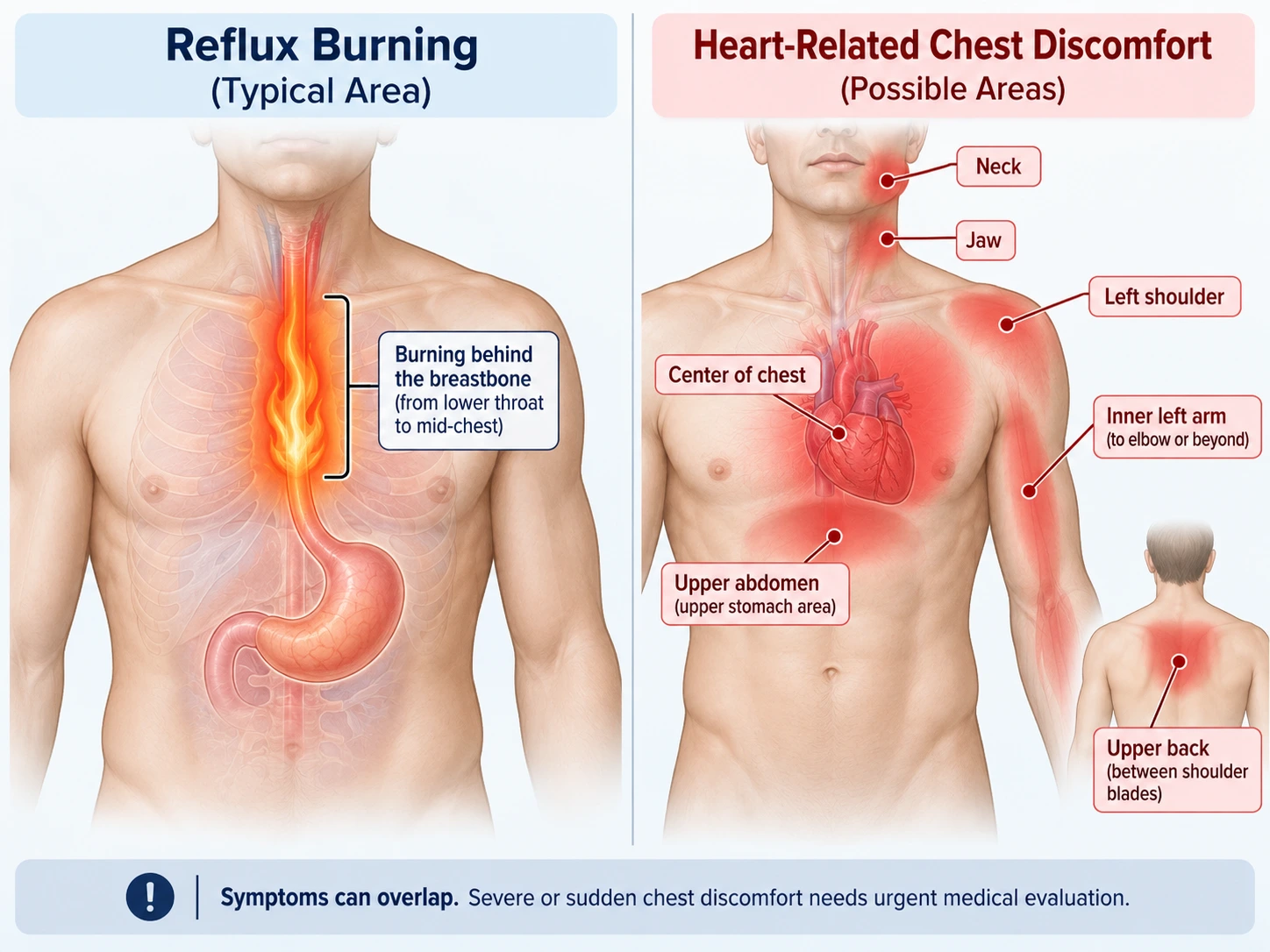
| Location | Burning behind the breastbone or in the upper abdomen; may rise towards the throat. | Centre or left of the chest; may spread to the arm, shoulder, back, neck, jaw or upper abdomen. |
| Nature of Discomfort | Burning, sour taste, bloating, fullness, belching. | Pressure, squeezing, tightness or heaviness; can also feel like burning or indigestion. |
| Relation to Meals | Often follows a large, spicy or oily meal, or lying down soon after eating. | Not reliably linked to meals; can occur after eating too, so timing alone settles nothing. |
| Physical Activity | Usually unrelated to exertion, though bending or lying flat may worsen it. | Often brought on by walking, climbing stairs or emotional stress, and may ease with rest in angina; a heart attack can also begin at rest. |
| Associated Symptoms | Regurgitation, bloating, burping, sour or bitter taste. | Breathlessness, cold sweat, nausea, light-headedness, unusual tiredness, a sense of unease. |
| Does It Recur? | Tends to return with triggers such as certain foods, late meals or posture. | May recur with exertion in a pattern; any change in pattern, or pain at rest, needs prompt review. |
| Emergency Assessment | If severe or sudden, or with fainting, breathlessness, vomiting blood or black stools. | Immediately whenever a heart attack is suspected. |
These are general patterns, not a checklist. Heart-related pain does not always feel severe. It can show up as burning, indigestion, pressure, tightness or a vague discomfort rather than sharp pain. Relief after an antacid, a burp, resting or changing position does not rule out a heart problem, and ongoing discomfort does not prove one. Never use an antacid as a test to decide whether you are having a heart attack.
Common Left-Side Chest Pain Causes
The left-side chest pain causes doctors consider run from trivial to life-threatening. Pain on the left is not automatically cardiac, and heart-related discomfort is just as likely to be felt in the centre of the chest, the upper abdomen, the jaw or the back.
Heart-Related Causes
- Coronary artery disease and angina: When the arteries supplying the heart are narrowed, the muscle may not get enough blood when demand rises, causing pressure or tightness during exertion or stress.
- Heart attack: A blocked coronary artery starves part of the heart muscle of blood. This is a medical emergency.
- Pericarditis: Inflammation of the lining around the heart often causes sharp pain that worsens on deep breathing or lying flat.
Digestive Causes
- Acid reflux and indigestion: Stomach acid or air moving upwards, or a sensitive stomach lining, can cause burning, bloating and pain behind the breastbone or in the upper left abdomen.
Chest Wall and Lung Causes
- Chest wall muscle strain: Pain after exercise, lifting or a bout of coughing, often worse with movement.
- Costochondritis: Inflammation where the ribs join the breastbone, causing a tender spot that hurts when pressed.
- Lung-related conditions: Pneumonia, pleurisy or a clot in the lung can cause chest pain, often with cough, fever or breathlessness. A clot in the lung is also an emergency.
Anxiety-Related Symptoms
Anxiety and panic can cause chest tightness, a racing heart and sweating. This explanation should be considered only after a medical assessment has looked for physical causes, because a heart problem can also make a person anxious.
Pain that reproduces when you press on the chest wall is more typical of a muscle or rib cause, but even that is a clue and not a guarantee. A doctor should make the call.
When Is Chest Pain Serious?
Knowing when is chest pain serious can save a life. Treat the following as warning signs that need emergency medical help:
- New, sudden, severe, persistent or unexplained chest discomfort.
- Pressure, squeezing, heaviness or tightness in the chest.
- Discomfort spreading to the arm, shoulder, back, neck, jaw or upper abdomen.
- Breathlessness, cold sweating, nausea, light-headedness or fainting.
- Symptoms triggered by physical exertion, or accompanied by unusual weakness.
Ambulance crews can start monitoring and treatment on the way and alert the hospital before you arrive. If someone collapses and is not breathing normally, call for help and begin CPR if you are trained.
Heart attacks do not always look like the dramatic scenes in films. Some people feel only mild discomfort, breathlessness, nausea or unusual fatigue, and some have few or no typical symptoms. This is more often described in women, older adults and people with diabetes. Our existing guide to the early warning signs of a heart attack covers these subtler symptoms in more detail.
Chest Pain or Gas After Eating: What Should You Know?
Acid reflux and indigestion are common reasons for discomfort after meals. Typical features include a burning feeling behind the breastbone, a sour or bitter taste, food or fluid coming back up, bloating and a sense of fullness. These symptoms often worsen when lying down soon after eating or bending forward.
Still, meal timing alone cannot separate acidity from a heart problem. Heart-related discomfort can begin after eating, and many people with angina describe it as indigestion. A person with a heart attack may also feel nauseated or bloated. So a sensible approach is to treat the pattern as a clue, not a verdict.
Some practical, general points. Smaller meals, avoiding late-night eating and limiting trigger foods may help ordinary reflux. But if the discomfort is new, different from your usual acidity, comes with breathlessness or sweating, or is brought on by walking or stairs, do not assume it is gas. If it is severe, sudden or persistent, seek emergency care instead of trying remedies at home.
When Should You Visit a Chest Pain Doctor?
Emergency Symptoms: Act Now
Any of the warning signs listed above, especially if they last more than a few minutes or keep returning, call for emergency care, not an appointment.
Non-Emergency Symptoms: Book a Timely Review
See a chest pain doctor (a cardiologist, or a physician who can refer you to one) promptly if you have:
- Chest discomfort that comes and goes, even if it passes quickly.
- Pressure or tightness during walking, stairs or exertion that settles with rest.
- "Acidity" that is new, increasing or not improving with usual measures.
- Unexplained breathlessness, palpitations or unusual tiredness.
- Any chest symptom in someone with diabetes, high blood pressure, high cholesterol, tobacco use or a family history of early heart disease.
An evaluation is also reasonable when you simply want certainty. A cardiologist can rule a cardiac cause in or out far more safely than guesswork.
How Does a Cardiologist Evaluate Chest Pain?
Evaluation starts with a conversation. The doctor will ask when the discomfort began, what it feels like, how long it lasts, what triggers or relieves it, where it spreads and what else you notice. Your medical history, medicines and family history matter too. A physical examination, including pulse, blood pressure and heart and lung sounds, follows, along with an assessment of your risk factors.
Depending on what the history and examination suggest, the following may be recommended:
- ECG (Electrocardiogram): A quick, painless recording of the heart's electrical activity, often the first test.
- Blood Tests: In an emergency setting, cardiac troponin is measured, usually more than once, to detect injury to the heart muscle. Other blood tests, such as sugar and cholesterol, help assess risk.
- 2D Echocardiography: An ultrasound that shows the heart's structure, valves and pumping function, used when clinically indicated.
- Treadmill Test (TMT) or Other Tests: Once initial assessment is done, exercise testing, Holter monitoring or further imaging may be advised in suitable patients.
Which tests are chosen depends on your symptoms, their timing, the examination and your overall risk. An ECG, or any single normal test, does not necessarily exclude every serious cardiac condition. An ECG captures one moment in time, which is why repeat or additional testing is sometimes needed if symptoms continue.
You can read more about these tests on our cardiac evaluation and heart tests page, the ECG service page, and in our guide to choosing between ECG, 2D Echo and TMT .
Who May Have a Higher Risk of Heart-Related Chest Pain?
Certain factors raise the likelihood that chest discomfort is coming from the heart:
- Diabetes.
- High blood pressure.
- High cholesterol.
- Smoking or other tobacco use.
- Older age.
- A family history of premature heart disease, commonly defined as a heart attack or heart disease in a father or brother before 55, or a mother or sister before 65.
People of South Asian origin also tend to develop coronary artery disease earlier than many other populations, which is worth remembering in an Indian family history.
Risk factors raise probability; they do not draw a line. Someone with none of these can still have a heart attack, so new or worrying chest symptoms deserve attention at any age.
Consulting a Cardiologist in Basaveshwar Nagar, Bangalore
If you want a cardiology opinion close to home, Dr. Sandeep's Heart Care Center & Labs is at No. 70, 1st Cross, Siddiah Puranik Road, near Shankar Matt Signal, Basaveshwaranagar, Bengaluru 560079.
Dr. Sandeep Shankar is listed on the centre's website as a Senior Interventional Cardiologist (MBBS, MD, DM Cardiology, FSCAI, FIC) with over 22 years of experience. Patients seeking a Cardiologist in Basaveshwar Nagar for chest discomfort, palpitations, breathlessness or blood pressure concerns can consult him during the centre's listed consultation hours of 4:00 PM to 8:00 PM; clinic and lab hours are 7:30 AM to 9:00 PM.
The centre offers ECG, 2D Echo, TMT and Holter monitoring, supported by in-house laboratory and radiology services. The doctor decides which tests, if any, are appropriate after reviewing your symptoms and clinical needs; you should not expect, or request, a fixed set of tests.
Important: A consultation visit is not a substitute for emergency care. If you suspect a heart attack, call emergency services and go to the nearest hospital with emergency facilities rather than waiting for a clinic appointment.
How to Reduce Future Heart Risks
No approach can guarantee prevention, but steady habits lower risk for most people:
- Check blood pressure and cholesterol regularly and know your numbers.
- Manage diabetes with the plan your doctor gives you, including blood sugar monitoring.
- Avoid tobacco in every form.
- Eat in a heart-healthy way: More vegetables, fruit, whole grains, pulses and nuts; less salt, refined sugar, deep-fried food and processed snacks.
- Stay physically active at a level suited to your health. Ask your doctor before starting vigorous exercise if you have symptoms or known heart disease.
- Take prescribed medicines as advised, and do not stop them because you feel well.
- Attend follow-ups when your doctor asks you to, even if symptoms have settled.
If you are exploring options for long-term management, see the centre's overview of cardiac treatment options .
Conclusion
The difference between recognising possible acidity and safely evaluating chest discomfort is that the first is a guess and the second is a process. Burning after a heavy meal is often gas, and pressure on climbing stairs is worth a cardiac check, but symptoms alone cannot reliably tell the two apart in every case.
When warning signs such as severe, sudden or persistent discomfort, spreading pain, breathlessness, sweating, nausea or fainting appear, act as if it could be your heart and call emergency services.
For recurring, unexplained or exertion-related symptoms that are not an emergency, a timely cardiology review brings clarity. If you are looking for a Cardiologist in Basaveshwar Nagar , you can contact Dr. Sandeep's Heart Care Center to arrange a consultation with Dr. Sandeep Shankar.
Book An Appointment
Looking for a Cardiologist in Basaveshwar Nagar? Dr. Sandeep's Heart Care Center & Labs is at No. 70, 1st Cross, Siddiah Puranik Road, near Shankar Matt Signal, Basaveshwaranagar, Bengaluru - 560079.
The centre offers cardiology consultation in Basaveshwar Nagar (listed consultation hours 4:00 PM to 8:00 PM) with ECG, 2D Echo, TMT and Holter monitoring.
Call +91 9620203065 (secondary: +91 9449444446) or visit www.drsandeepheartcarecenter.com .
Symptoms that suggest a heart attack need emergency services immediately; a clinic consultation is not a substitute.
.webp)
.png)