
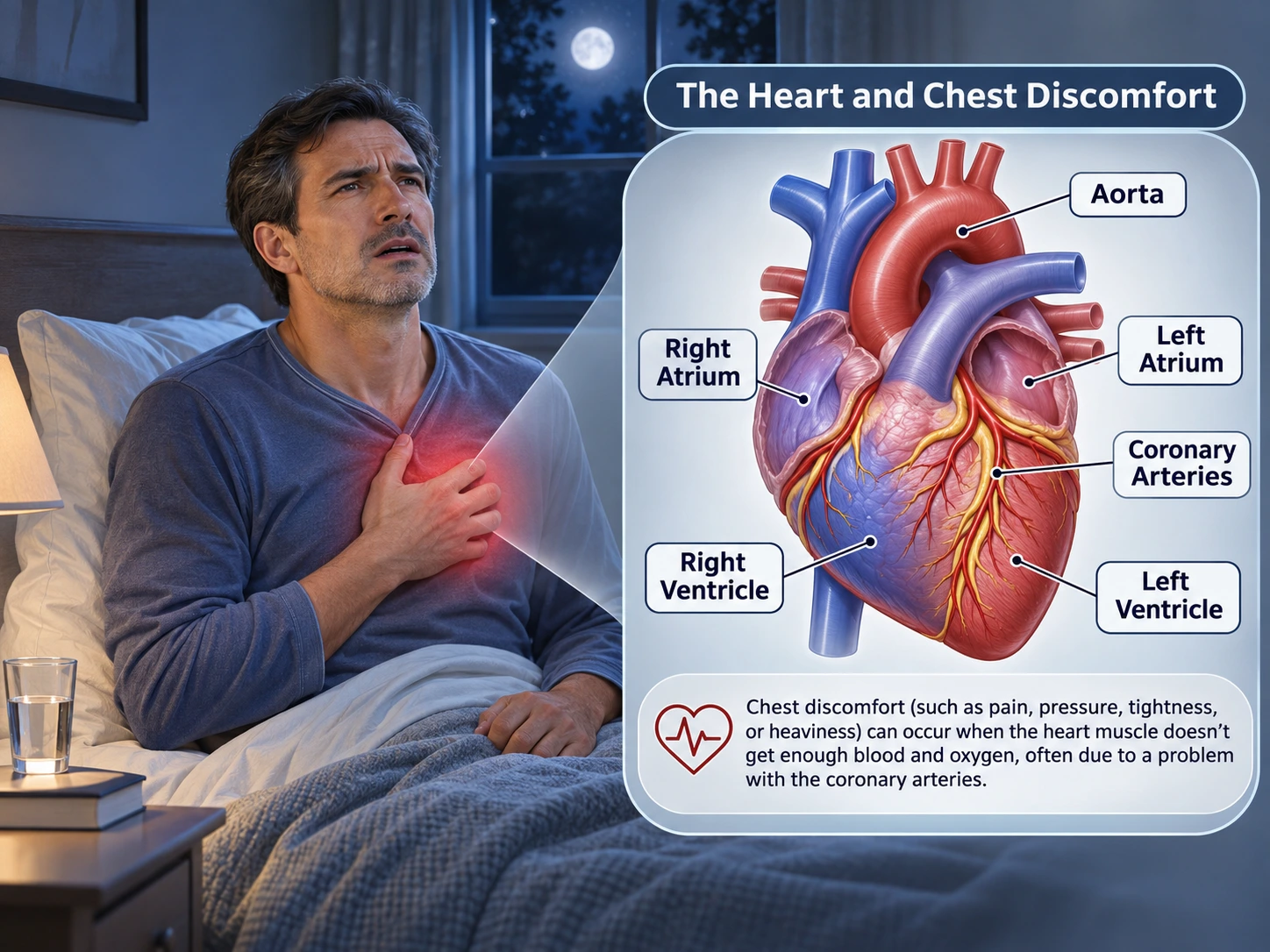
Chest Pain at Night in Bangalore: When to Call an Ambulance and When a Clinic Visit Is Enough
You wake at 2 a.m. with a tight, heavy feeling in your chest. The house is quiet, the clinic is closed, and a voice in your head says it is probably just gas. Many families in Bengaluru make this decision every week: sip some water, take an antacid and wait for morning.
That instinct is understandable, but chest pain that begins at night should never be dismissed automatically as acidity, gas or a pulled muscle. Chest pain has many causes. Some are heart-related. Others involve the food pipe, the chest wall, the lungs or anxiety. The time of day cannot tell you which one it is.
This guide is written for patients and families in Basaveshwaranagar and across Bengaluru. It explains why chest discomfort can appear at night, which warning signs call for an ambulance, what to do while help is on the way, and how a Cardiologist in Basaveshwar Nagar assesses chest pain once an emergency has been dealt with or ruled out.
Quick answer
- Call 112 or 108 for an ambulance immediately if chest pain, pressure or tightness is sudden, severe, lasts more than a few minutes, keeps coming back, or comes with breathlessness, cold sweating, nausea, fainting, severe dizziness or collapse, or if the pain spreads to the arm, jaw, neck or back.
- A suspected heart attack is an emergency, not a reason to book a clinic appointment. Do not wait for morning and do not drive yourself.
- A prompt clinic assessment may be appropriate only when you are stable, have no warning signs and a heart attack is not suspected. An example is mild, recurring discomfort that a doctor has already assessed.
- Symptoms alone cannot reliably rule out a heart attack. If you are unsure, treat it as an emergency.
Why Does Chest Pain Occur at Night?
Chest pain does not become more dangerous simply because it is dark outside. But night does change what happens in the body and what a person notices.
When you lie flat, stomach contents move back towards the food pipe more easily. This is why reflux-related burning often becomes noticeable after lying down. Lying flat also shifts blood towards the chest, so people with certain heart or lung conditions may feel breathless or uncomfortable in bed. With fewer distractions at night, a sensation that went unnoticed during a busy day can suddenly feel prominent.
Heart-related chest pain can also occur at rest or during sleep. Heart rate and blood pressure follow a daily rhythm, and some cardiac problems are reported more often at night or in the early morning. One example is a form of angina caused by temporary spasm of a coronary artery. A heart attack does not need physical exertion to begin.
Reflux, a respiratory infection or a strained chest-wall muscle can also announce themselves at night. The key point is that the timing of chest pain alone cannot identify its cause. This is why doctors take a cautious approach and consider a cardiac cause until it has been properly assessed.
Common Causes of Chest Pain at Night
Heart-Related Chest Pain
Cardiac chest pain is often described as pressure, heaviness, tightness, squeezing or a dull ache, rather than a sharp stab. It may sit in the centre or left of the chest, or it may be felt mainly in the arm, jaw, back or upper abdomen. Heart-related causes include:
- Angina: discomfort that occurs when the heart muscle does not receive enough blood for its needs. It is usually linked to narrowed coronary arteries and often appears with exertion or stress. A form caused by temporary artery spasm can occur at rest, including at night.
- Acute coronary syndrome: an umbrella term for conditions in which blood flow to part of the heart muscle suddenly falls. It includes unstable angina and heart attack and needs emergency assessment.
- Heart attack (myocardial infarction): a blocked coronary artery injures the heart muscle. Treatment is time-sensitive.
- Other cardiac conditions: inflammation of the lining around the heart (pericarditis), which often causes sharp pain that is worse when lying flat or breathing in; heart failure, which may cause breathlessness when lying down; and abnormal heart rhythms, which may cause palpitations, chest discomfort or light-headedness.
Acid Reflux and GERD
In acid reflux, stomach acid moves back towards the food pipe (oesophagus). When this happens often, it is called gastro-oesophageal reflux disease (GERD). A late or heavy meal, lying down soon after eating, or bending forward can bring on burning behind the breastbone, a sour taste or regurgitation.
The food pipe lies close to the heart, and the two share overlapping nerve pathways. Reflux burning can therefore resemble cardiac discomfort, and some people having angina or a heart attack describe indigestion-like symptoms. Relief after an antacid or a burp does not rule out a heart problem. Unexplained chest pain should not be assumed to be acidity. Our guide on chest pain or gas and when it needs a cardiologist explains how the two overlap.
Muscle Strain and Chest Wall Pain
Strain of the muscles between the ribs (intercostal muscles), costochondritis (inflammation where the ribs join the breastbone) and other chest wall inflammation can cause pain that is localised and worse with movement, deep breaths, coughing or pressure on the chest. A sleeping position can aggravate it.
These causes are common and often harmless. But pain characteristics alone cannot safely exclude a cardiac cause, and a person with chest wall pain can also have a heart problem. A doctor should make that judgement.
Respiratory Causes
Respiratory infections, pleurisy (inflammation of the lining of the lungs), pneumonia, asthma and other lung conditions can cause night-time chest discomfort. Clues include cough, fever, wheeze, phlegm and pain that worsens on breathing in. Difficulty breathing, bluish lips, or sudden sharp chest pain with breathlessness need emergency care. A blood clot in the lung can present this way.
Anxiety and Panic Episodes
Anxiety and panic can cause chest tightness, palpitations, sweating, trembling and breathlessness, and they sometimes wake a person from sleep. These symptoms are real and deserve care. However, a heart problem can also cause anxiety, and the two can look alike. New or unexplained chest pain should not automatically be put down to anxiety. Physical causes need to be looked at first.
Heart Attack Warning Signs That Can Occur at Night
A heart attack happens when blood flow to part of the heart muscle is blocked. Common warning signs of a possible heart attack include:
- Pressure, squeezing or heaviness in the chest.
- Chest discomfort that lasts several minutes, or goes away and returns.
- Pain spreading to the arms, shoulders, back, neck, jaw or upper abdomen.
- Breathlessness, with or without chest discomfort.
- Cold sweating.
- Nausea or vomiting.
- Dizziness or light-headedness.
- Unusual weakness or fatigue.
Not everyone has all of these. Heart attack symptoms vary, and they do not always involve severe chest pain. Some people notice only mild discomfort, breathlessness or unusual tiredness. Women, older adults and people with diabetes are more likely to have less typical symptoms, such as nausea, back or jaw pain, or fatigue without obvious chest pain. So the absence of severe pain does not mean the heart is safe.
When to Go to Emergency for Chest Pain?
Knowing when to go to emergency for chest pain protects heart muscle and can save a life. Emergency medical assistance is needed for:
- New or unexplained chest pressure or tightness.
- Persistent or recurring chest discomfort.
- Chest pain with breathlessness.
- Chest discomfort with cold sweating.
- Pain spreading to the arm, jaw, neck or back.
- Chest pain with fainting or severe dizziness.
- Sudden chest pain with significant weakness or collapse.
- Any suspected heart attack symptoms.
Important instructions:
- Do not wait for the pain to become severe.
- Do not wait until morning if a heart attack is suspected.
- Do not assume the pain is gas or acidity.
- Do not drive yourself to the hospital.
- Call 112 or 108 in India for emergency ambulance assistance, subject to local service availability.
- Follow the emergency dispatcher’s instructions.
An emergency department is the right place for a suspected heart attack and for other serious causes of chest pain. ECG, cardiac monitoring, blood tests and treatment can begin there without delay.
Chest Pain Emergency Bangalore: When Should You Call an Ambulance?
In a chest pain emergency Bangalore families often ask whether it is quicker to use their own car or a cab. When a serious cardiac event is suspected, an ambulance for chest pain is generally the safer choice, for these reasons:
- A heart attack can trigger a dangerous heart rhythm. In a private vehicle, there is no way to monitor or treat the person if that happens.
- Emergency responders can check pulse, blood pressure and other vital signs and begin initial care on the way. The level of care depends on the type of ambulance.
- The dispatcher can guide you by phone, including through CPR if needed.
- Waiting, searching for a vehicle or sitting in traffic adds delay when time matters most.
In India, 112 is the national emergency number. In Karnataka, 108 is the state’s emergency ambulance number. Availability, response time and the equipment on board depend on the provider, your location and the time of day, and private ambulance services also operate in the city. Save these numbers in your phone and note which nearby hospitals have an emergency department. At the emergency department, ECG assessment, cardiac monitoring, blood tests and further treatment can be provided when indicated. The exact services depend on the hospital.
Call an ambulance immediately for suspected heart attack symptoms, severe or persistent chest pain, chest discomfort with breathlessness, fainting, cold sweating or collapse.
Seek prompt medical assessment for new, unexplained or recurring chest discomfort without emergency warning signs, provided the person is stable. A clinician should decide the appropriate assessment. If symptoms worsen or emergency features develop, call an ambulance.
A routine clinic visit is not a substitute for emergency evaluation when a heart attack is suspected.
Heart Attack First Aid India: What Should You Do Before the Ambulance Arrives?
These steps follow widely used first-aid guidance. For heart attack first aid India families can follow, the order matters: call first, then help the person.
- Stop all physical activity immediately.
- Help the person sit or rest in a comfortable position.
- Call 112 or 108 for emergency assistance.
- Keep the person calm and limit unnecessary movement.
- Loosen tight clothing if needed.
- Do not allow the person to drive themselves.
- Do not give food, drinks or unprescribed medicines. If a doctor has prescribed a heart medicine for chest pain, it should be used exactly as the doctor instructed.
- Stay on the line and follow the emergency dispatcher’s instructions.
What about aspirin? Emergency professionals may advise chewing aspirin in some suspected heart attack situations. It is not appropriate for everyone. Allergy, bleeding risk and other medical conditions must be considered. Do not delay calling for help to find aspirin. Follow the emergency operator’s or a qualified clinician’s advice rather than self-medicating.
If the person becomes unconscious:
- Check whether the person responds and is breathing normally.
- Call emergency services and follow the dispatcher’s instructions.
- If the person is unresponsive and not breathing normally, begin CPR if you are trained, or follow dispatcher-guided CPR. Hands-only CPR means pushing hard and fast in the centre of the chest.
- If an automated external defibrillator (AED) is available, use it and follow its voice instructions.
Do not delay CPR to look for medication.
Chest Pain at Night: When Is a Clinic Visit Enough?
This section needs care, because there is no safe pain score or symptom checklist that separates a harmless night from a dangerous one.
A clinic consultation can be suitable when the person is stable, has no emergency warning signs, and a serious acute condition is not suspected. Examples include:
- Mild, recurring discomfort that a clinician has already assessed.
- Symptoms linked to a previously diagnosed non-emergency condition.
- Stable symptoms without emergency warning signs that still need medical review.
Even then, new or unexplained chest pain should receive timely professional assessment. Please keep these points in mind:
- No symptom description or pain score can reliably rule out a heart attack at home.
- Do not decide that chest pain is harmless because of your age, how mild it feels, or because one typical symptom is missing.
- If a cardiac cause is suspected, emergency evaluation is necessary.
- If you are unsure whether it is an emergency, treat it as one and call 112 or 108.
How Do Doctors Diagnose Chest Pain?
Doctors usually work through the following steps, choosing only what is relevant to the person:
- A detailed symptom history.
- The duration, location and nature of the pain.
- Associated symptoms such as breathlessness, sweating or nausea.
- Medical and family history.
- Blood pressure, pulse and a physical examination.
- An ECG.
- Cardiac blood tests such as high-sensitivity troponin, when indicated.
- 2D echocardiography, where clinically appropriate.
- Further cardiac investigations depending on the findings.
An ECG is an important early test, but a single normal ECG does not always exclude a heart attack. Repeat ECGs, repeat blood tests and a period of observation may be needed. Not every person with chest pain needs every test.
ECG and Other Tests for Suspected Heart Problems
An ECG (electrocardiogram) records the heart’s electrical activity. It is commonly done early in suspected cardiac chest pain because it can show signs of a heart attack, reduced blood supply or an abnormal rhythm. It is quick and painless, but it captures only one moment in time.
Troponin is a protein released when heart muscle is injured. A blood test for high-sensitivity troponin, often repeated after a few hours, helps identify heart muscle injury. Echocardiography uses ultrasound to show the heart’s chambers, valves and pumping function. It may be useful when the history, examination or ECG suggests a structural or functional problem.
Further tests depend on the clinical assessment. They may include a treadmill test, rhythm monitoring or imaging of the coronary arteries.
It helps to separate two situations. In an emergency, the aim is to quickly find or exclude acute coronary syndrome, which is done in an emergency department. In routine outpatient cardiac assessment, a cardiologist reviews symptoms and risk factors and chooses tests at a planned pace. You can read about the options on our cardiac evaluation and heart tests page.
Who Has a Higher Risk of Heart-Related Chest Pain?
The following factors raise the likelihood of heart-related chest pain:
- High blood pressure.
- Diabetes.
- High cholesterol.
- Smoking and tobacco use.
- Existing heart disease.
- A family history of premature cardiovascular disease.
- Older age.
- Obesity.
- Physical inactivity.
- Chronic kidney disease.
Risk factors raise the probability, but they do not draw a line. Heart attacks can also occur in people without recognised risk factors. Having none of these does not make chest pain safe to ignore.
Cardiologist in Basaveshwar Nagar: When Should You Seek a Cardiology Consultation?
Once emergency features are absent, a cardiology consultation helps when chest discomfort keeps recurring, remains unexplained, or has been looked at before but not fully assessed. It is also sensible if you have breathlessness, palpitations, or risk factors such as diabetes and high blood pressure.
Dr. Sandeep Shankar is listed on the centre’s website as a Senior Interventional Cardiologist (MBBS, MD, DM Cardiology, FSCAI, FIC). He consults at Dr. Sandeep’s Heart Care Center & Labs, No. 70, 1st Cross, Siddiah Puranik Road, near Shankar Matt Signal, Basaveshwaranagar, Bengaluru – 560079. For people looking for a Cardiologist in Basaveshwar Nagar, or a Cardiologist in Bangalore within reach of west Bengaluru, the centre’s website lists consultation hours of 4:00 PM to 8:00 PM and clinic and lab hours of 7:30 AM to 9:00 PM.
At a first visit, the cardiologist reviews symptoms, history and risk factors, checks blood pressure and pulse, and may advise tests. The centre lists ECG, 2D Echo, TMT and Holter monitoring, with in-house laboratory and radiology services. The doctor decides which tests, if any, are suitable after assessment. Not every person with chest pain needs these investigations.
Important: The centre is a cardiology consultation and diagnostic centre, not an emergency department. A clinic consultation is not a replacement for emergency department assessment when a heart attack or another serious condition is suspected. For chest pain at night, or at any time when a heart attack is suspected, call 112 or 108.
How Can You Reduce Your Risk of Heart Disease?
No approach can guarantee prevention, but steady habits lower risk for most people:
- Monitor your blood pressure regularly.
- Manage diabetes with the plan your doctor has given you.
- Monitor cholesterol with periodic blood tests.
- Avoid tobacco in every form.
- Maintain a balanced diet with more vegetables, fruit, whole grains and pulses, and less salt, sugar and deep-fried food.
- Follow regular physical activity according to medical advice. Ask your doctor first if you have symptoms or known heart disease.
- Maintain a healthy weight.
- Get adequate sleep.
- Take prescribed medicines as advised and do not stop them because you feel well.
- Attend recommended health check-ups.
Lifestyle changes do not replace emergency assessment or prescribed medical treatment.
Conclusion
Chest pain at night can come from the heart, the food pipe, the chest wall, the lungs or anxiety, and its timing alone cannot reveal which. Cardiac pain often feels like pressure, tightness or heaviness, but it can mimic indigestion, and non-cardiac pain can feel alarming. Neither can be reliably told apart at home.
If you notice heart attack warning signs, such as chest pressure, pain spreading to the arm or jaw, breathlessness, cold sweating, nausea or fainting, call 112 or 108 for an ambulance. Early emergency assessment matters when a heart attack is suspected. A clinic consultation is appropriate for stable, non-emergency symptoms that still need medical review.
If you are looking for a Cardiologist in Basaveshwar Nagar or a Cardiologist in Bangalore for recurring or previously assessed chest discomfort, you can contact Dr. Sandeep’s Heart Care Center to arrange a consultation with Dr. Sandeep Shankar.
Emergency reminder: Anyone experiencing suspected heart attack symptoms should call emergency services immediately rather than waiting for a clinic appointment.
Disclaimer: This article is for general education and does not replace individual medical advice, diagnosis or treatment. Please consult a qualified healthcare professional about your own symptoms.
.webp)
.png)