
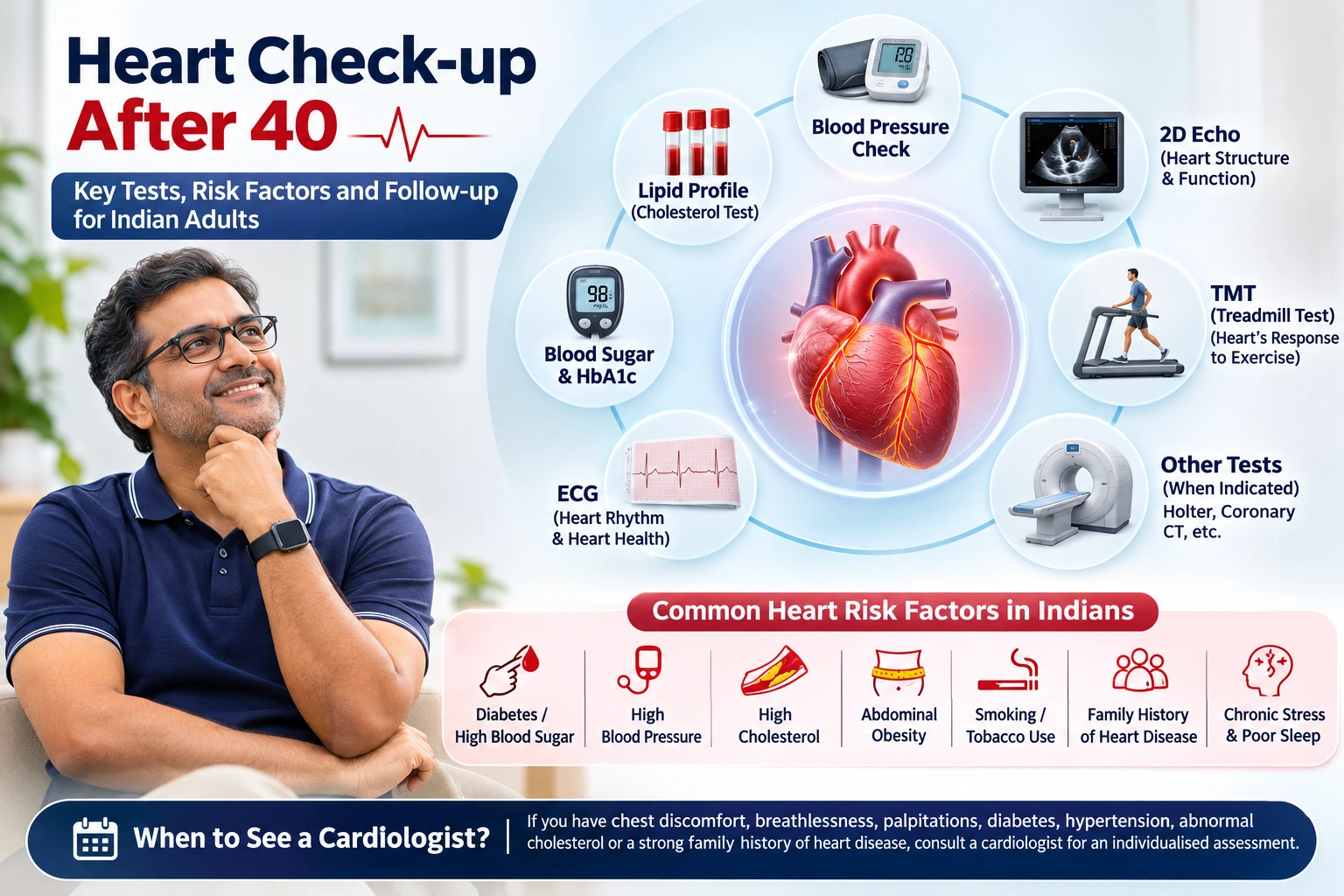
Heart Check-up After 40: Tests, Risk Factors and Follow-up for Indian Adults
For many people, the forties bring a quiet shift: responsibilities peak, exercise slips, and the first slightly high sugar or cholesterol report arrives. Adults often start searching for a Heart Specialist in Rajajinagar or elsewhere in Bengaluru, wondering whether a heart check-up is needed even without symptoms.
The short answer is that heart health after 40 deserves attention, but the right check-up is personal. Cardiovascular risk generally rises with age, and high blood pressure, diabetes, abnormal cholesterol, obesity, smoking and family history all influence it, often without symptoms. Heart risk factors in Indians deserve particular attention, because coronary artery disease tends to appear at younger ages in South Asians than in many other populations.
After 40, a heart check-up usually begins with a doctor's review of your symptoms and family history, along with blood pressure, lipid profile and blood sugar (HbA1c) tests. An ECG, 2D echocardiography or treadmill test (TMT) is added only when symptoms or your risk assessment make it useful. How often to repeat checks depends on your personal risk, not on a fixed calendar.
Turning 40 does not mean you have heart disease, or that you need every test available. This guide explains risk factors, what each test does, and which symptoms should never wait.
Why Does Heart Health Become Important After 40?
Arteries change gradually with age: fatty deposits (plaque) can build up and vessels can stiffen. The process is slow and usually silent, so risk assessment is more useful than waiting for symptoms.
- Blood pressure, cholesterol and blood sugar often drift upwards with age, weight gain and reduced activity, so monitoring matters.
- Diabetes and metabolic conditions affect blood vessels and often occur alongside high blood pressure and abnormal lipids.
- Sedentary routines and diet influence weight and metabolic health.
- Family history matters, especially if a close relative had a heart attack young.
- Some conditions stay unnoticed, since high blood pressure and abnormal cholesterol usually cause no discomfort.
A preventive assessment shows which of these apply to you.
Common Heart Risk Factors in Indians
The ICMR-INDIAB national survey, published in The Lancet Diabetes & Endocrinology in 2023, estimated that about 11.4% of Indians have diabetes, 15.3% have prediabetes, 35.5% have hypertension and 39.5% have abdominal obesity. These are population estimates, not individual predictions.
Diabetes and High Blood Sugar
In type 2 diabetes the body responds poorly to insulin (insulin resistance) and glucose stays high. Prediabetes means levels are above normal but below the diabetes range. Persistently raised glucose can injure blood vessel linings and speed up artery narrowing, which is why fasting glucose and HbA1c tests help. Asians tend to develop diabetes at lower body weights than many other populations, so a normal-looking weight does not guarantee a normal sugar level.
High Blood Pressure
Hypertension means blood pressure stays persistently high. It is often called a silent condition because people may feel completely well. Uncontrolled pressure strains the heart and damages arteries, raising the risk of heart attack, heart failure, stroke and kidney problems.
High Cholesterol and Abnormal Lipid Levels
LDL cholesterol can deposit in artery walls and form plaque, HDL helps carry cholesterol away, and triglycerides are another blood fat that rises with excess sugar, refined carbohydrates and alcohol. Many Indians show high triglycerides with low HDL even when total cholesterol looks acceptable, so the full profile matters.
Family History of Heart Disease
Premature cardiovascular disease in a close relative is usually defined as a heart attack in a father or brother before 55, or a mother or sister before 65. It can raise your risk without meaning you will develop disease.
Abdominal Obesity and Physical Inactivity
Indians tend to store fat around the abdomen, linked to insulin resistance, high blood pressure and abnormal lipids even at modest body weights. Inactivity compounds this, so waist size is a useful clue alongside weight.
Smoking, Tobacco and Alcohol
Smoking damages blood vessel linings, promotes clotting and lowers HDL. Bidis and smokeless tobacco such as khaini and gutka are common in India and are not safer alternatives. Heavy alcohol use can raise blood pressure and triglycerides, so limiting or avoiding it is safer.
Unhealthy Dietary Habits
Higher-risk patterns include excess salt (pickles, papad, namkeen), saturated and trans fats (vanaspati, reheated frying oil), processed foods, added sugar, refined carbohydrates, and too little fruit, vegetables and fibre.
Stress and Poor Sleep
Chronic stress, short sleep and untreated sleep apnoea (loud snoring with daytime sleepiness) are linked with higher blood pressure and weight gain. No single factor decides whether someone develops heart disease; risk comes from combinations, and many can be modified.
What Are the Important Cardiac Screening Tests After 40?
Cardiac screening tests are selected according to individual risk and clinical findings. Simple measurements come first; heart-specific tests are added only when indicated. The doctor decides which, if any, of the cardiac evaluation and heart tests apply to you.
Blood Pressure Measurement
Systolic pressure is measured when the heart contracts and diastolic between beats, written as, for example, 120/80 mmHg. Regular measurement is the simplest way to catch hypertension; if readings are borderline, a doctor may ask for home readings or ambulatory blood pressure monitoring. No single schedule suits everyone.
Lipid Profile Test
This blood test reports total cholesterol, LDL, HDL and triglycerides. Results are read alongside age, blood pressure, diabetes, smoking and family history to estimate risk, and may lead to lifestyle changes or, in some people, medicines. Your doctor will say whether fasting is needed.
Blood Sugar and HbA1c Test
Fasting glucose shows sugar after an overnight fast; HbA1c reflects the average over two to three months. Together they screen for prediabetes and diabetes. How often to test depends on your risk factors and any existing diagnosis.
Electrocardiogram (ECG)
An ECG is a painless test taking a few minutes. Electrodes record the heart's electrical activity, showing rhythm problems or signs of an earlier heart attack or strain. It is commonly used to evaluate chest discomfort, palpitations or breathlessness. It is not a universal screening test: for low-risk adults without symptoms, the US Preventive Services Task Force advises against routine ECG screening. A normal resting ECG also cannot rule out every condition, because blockages may not alter a tracing taken at rest.
2D Echocardiography
2D echocardiography uses ultrasound, without radiation, to show heart chambers, valves, pumping function and structure. It may be recommended for breathlessness, ankle swelling, a murmur, an abnormal ECG, or suspected heart failure or valve disease, but not routinely for every healthy adult above 40.
Treadmill Test (TMT)
In a treadmill test (TMT), you walk on a treadmill whose speed and slope increase in stages while ECG, heart rate and blood pressure are monitored. It may be considered for exertional chest discomfort or breathlessness, or in selected people at intermediate risk. It is unsuitable for some, such as those with unstable chest pain or difficulty walking, and results can be normal despite a blockage or abnormal without one. The doctor decides suitability.
Additional Cardiac Investigations
- Holter monitoring: continuous ECG recording, usually for 24 to 48 hours.
- Coronary artery calcium scoring: a CT scan measuring calcium in coronary arteries, sometimes used when risk is uncertain.
- Coronary CT angiography: CT imaging of the arteries with contrast dye, for selected people with symptoms.
- Other specialised tests, such as stress imaging, cardiac MRI or angiography, when earlier results call for them.
None of these, nor ambulatory blood pressure monitoring, is routinely required for everyone over 40; the choice depends on symptoms, risk and the doctor's advice.
How Often to Get a Heart Check Up After 40?
There is no single schedule for how often to get a heart check up. It depends on age, blood pressure, cholesterol, diabetes, smoking, family history and earlier results. A healthy adult with normal values may need only periodic review, while diabetes or hypertension calls for closer monitoring. New symptoms should be assessed promptly rather than left for the next routine visit.
| Health Profile | Follow-up Considerations |
|---|---|
| Healthy adults above 40 without known risk factors | Periodic preventive health assessment based on age and clinical guidance |
| Adults with high blood pressure | Regular blood pressure monitoring and doctor-advised reviews |
| Adults with diabetes | Individualised blood sugar and cardiovascular risk monitoring |
| Adults with abnormal cholesterol | Repeat lipid assessment according to treatment and risk |
| Adults with multiple cardiovascular risk factors | Individualised cardiovascular risk evaluation and follow-up |
| Adults with known heart disease | Follow-up according to the treating cardiologist's advice |
Heart Check-up After 40 for People With Diabetes and High Blood Pressure
Diabetes and hypertension each raise cardiovascular risk, and together they compound it, so controlling both matters. A review may include blood pressure monitoring, blood sugar and HbA1c, and a lipid profile, with an ECG or echocardiography added if there are symptoms or abnormal findings. Prescribed medicines and follow-ups matter as much as tests, and not everyone needs every cardiac test. The clinic's pages on high blood pressure and heart health in people with diabetes give more background.
Are Cardiac Screening Tests Necessary Without Symptoms?
Preventive assessment estimates future risk, while diagnostic testing looks for the cause of symptoms. Without symptoms, checking blood pressure, cholesterol and diabetes risk is useful because these factors are silent but treatable. Routinely adding ECG, TMT, echocardiography or advanced imaging in low-risk adults may bring no extra benefit and can trigger unnecessary further tests. A doctor should decide the right approach, and a normal result never guarantees freedom from heart disease.
Warning Signs of Heart Problems That Should Not Be Ignored
Seek medical attention for:
- Chest pain, pressure, tightness or discomfort.
- New or severe breathlessness.
- Pain spreading to the arm, shoulder, back, neck or jaw.
- Unexplained sweating with chest discomfort.
- Dizziness, fainting, sudden weakness, or palpitations with chest discomfort.
- Unusual tiredness or reduced exercise tolerance.
Heart attack symptoms vary; some people, including those with diabetes, notice breathlessness, nausea or tiredness rather than classic chest pain.
Emergency: if you or someone near you has symptoms suggestive of a heart attack or another serious cardiac emergency, call 112 or your local emergency ambulance service immediately. Do not wait for a routine cardiology appointment and do not drive yourself to hospital. See also: chest pain or gas.
How to Maintain Heart Health After 40
For heart health after 40, these habits help, though none guarantees prevention of heart disease:
- Eat vegetables, fruit, whole grains, pulses and fibre, choose healthier fats, and maintain an appropriate weight.
- Keep salt low; the WHO advises under 5 grams a day.
- Stay active; the WHO suggests 150 to 300 minutes of moderate activity a week for adults, adjusted to individual health.
- Avoid tobacco and nicotine, and limit or avoid alcohol.
- Sleep adequately and manage stress.
- Monitor blood pressure, and check blood sugar and cholesterol when indicated.
- Take prescribed medicines as advised and attend follow-ups.
People with existing heart conditions should consult their doctor before starting a new exercise routine. The clinic also lists diet and lifestyle management.
When Should You Consult a Cardiologist After 40?
A cardiology consultation may help if you have persistent chest discomfort, breathlessness during routine activities, recurrent palpitations, abnormal ECG findings, hypertension or diabetes with other cardiovascular concerns, an abnormal lipid profile with other risk factors, a strong family history of premature heart disease, known cardiovascular disease, or a doctor's recommendation. Emergency symptoms need immediate medical assistance, not a routine appointment.
Consulting a Heart Specialist in Rajajinagar
If you are looking for a Heart Specialist in Rajajinagar, one practical detail comes first. Dr Sandeep's Heart Care Center & Labs is in Basaveshwaranagar, not within Rajajinagar itself, and serves patients travelling from Rajajinagar and nearby parts of West Bengaluru. Dr. Sandeep Shankar, listed on the website as a Senior Interventional Cardiologist and Heart Specialist (MBBS, MD, DM Cardiology, FSCAI, FIC), consults there. See the page for patients seeking a Cardiologist in Rajajinagar or Dr. Sandeep Shankar's profile.
The website lists consultation with ECG, 2D echocardiography, TMT, Holter monitoring and laboratory services. When clinically indicated, these can support cardiovascular assessment in one place, but no patient needs all of them. Bring earlier reports and current medicines, and call ahead to confirm availability. A suspected heart attack or other serious emergency needs emergency care at once, not a clinic appointment.
Conclusion
Heart health after 40 deserves attention, particularly for Indian adults with diabetes, high blood pressure, abnormal cholesterol, family history or tobacco use. Blood pressure, cholesterol and blood sugar checks form the core of preventive care, while ECG, echocardiography and TMT are used when clinically appropriate. Cardiac screening tests should follow your history and a doctor's assessment, and how often to get a heart check up should be set by personal risk, not a universal rule.
For an individualised plan, you can contact Dr. Sandeep's Heart Care Center to arrange a consultation with Dr. Sandeep Shankar, whose Basaveshwaranagar clinic serves patients looking for a Heart Specialist in Rajajinagar. Chest pain, severe breathlessness or fainting needs emergency help immediately.
Disclaimer: This article is for general education and does not replace individual medical advice, diagnosis or treatment. Please consult a qualified doctor about your own health.
.webp)
.png)